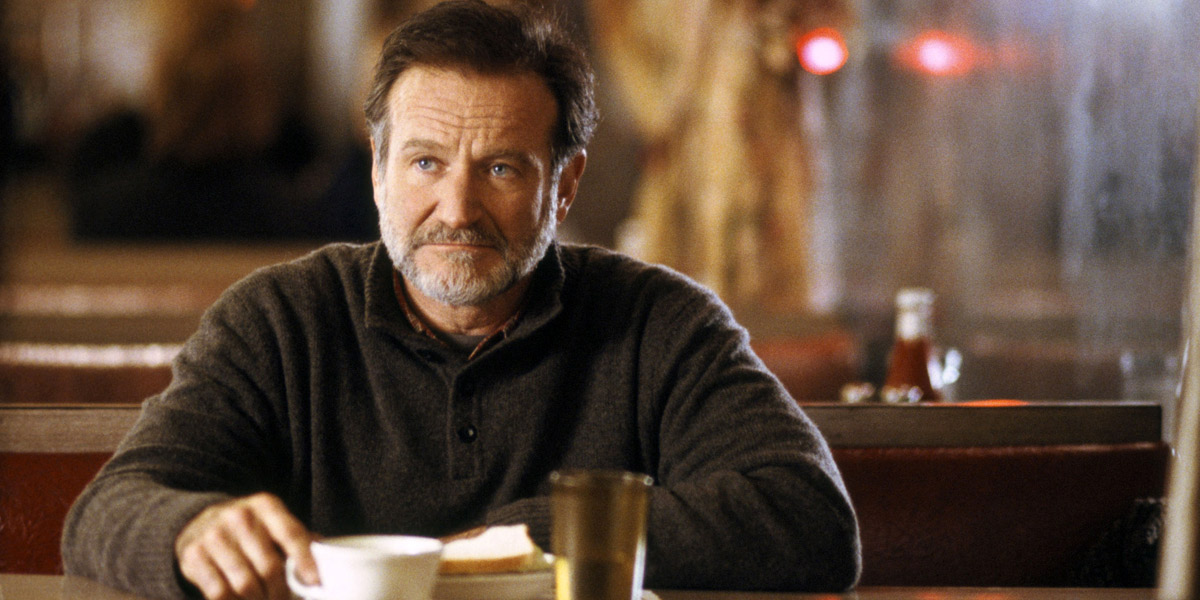
Robin Williams was a comic supernova whose explosions of pop culture riffs and impressions dazzled audiences for decades and made him a gleamy-eyed laureate for the Information Age.
The Academy Award-winning actor, who died at his home in California at 63, had an astonishing career.
From his breakthrough in the late 1970s as the alien in the hit TV show Mork and Mindy, through his stand-up act and such films as Good Morning, Vietnam, the short, barrel-chested Williams ranted and shouted as if just sprung from solitary confinement.
Loud, fast, manic, he parodied everyone from John Wayne to Keith Richards, impersonating a Russian immigrant as easily as a pack of Nazi attack dogs.
He was a riot in drag in Mrs Doubtfire, or as a cartoon genie in Aladdin. He won his Academy Award in a rare, but equally intense dramatic role, as a teacher in the 1997 film Good Will Hunting.
Following Williams on stage, Billy Crystal once observed, was like trying to top the Civil War. In a 1993 interview with the Associated Press, Williams recalled an appearance early in his career on The Tonight Show starring Johnny Carson. Bob Hope was also there.
“It was interesting,” Williams said. “He was supposed to go on before me and I was supposed to follow him, and I had to go on before him because he was late. I don’t think that made him happy. I don’t think he was angry, but I don’t think he was pleased.
You might like

“I had been on the road and I came out, you know, gassed, and I killed and had a great time. Hope comes out and Johnny leans over and says, ‘Robin Williams, isn’t he funny?’ Hope says, ‘Yeah, he’s wild. But you know, Johnny, it’s great to be back here with you’.”
In 1992, Carson chose Williams and Bette Midler as his final guests.
Like so many funnymen, he had serious ambitions, winning his Oscar for his portrayal of an empathetic therapist in Good Will Hunting. He also played for tears in Awakenings, Dead Poets Society and What Dreams May Come, something that led New York Times critic Stephen Holden to once say he dreaded seeing the actor’s “Humpty Dumpty grin and crinkly moist eyes”.
Williams also won three Golden Globes, for Good Morning, Vietnam, Mrs Doubtfire and The Fisher King.
"“You look at the world and see how scary it can be sometimes and still try to deal with the fear”"
His other film credits included Robert Altman’s Popeye (a box office bomb), Paul Mazursky’s Moscow on the Hudson, Steven Spielberg’s Hook and Woody Allen’s Deconstructing Harry. On stage, Williams joined fellow comedian Steve Martin in a 1988 Broadway revival of Waiting for Godot.
“I dread the word ‘art’,” Williams told the AP in 1989.
“That’s what we used to do every night before we’d go on with Waiting for Godot. We’d go, ‘No art. Art dies tonight.’ We’d try to give it a life, instead of making Godot so serious. It’s cosmic vaudeville staged by the Marquis de Sade.”
Subscribe for updates
His personal life was often short on laughter. He had acknowledged drug and alcohol problems in the 1970s and ’80s and was among the last to see John Belushi before the Saturday Night Live star died of a drug overdose in 1982.
Williams announced in recent years that he was again drinking but rebounded well enough to joke about it during his recent tour. “I went to rehab in wine country,” he said, “to keep my options open.”
Born in Chicago in 1951, Williams would remember himself as a shy kid who got some early laughs from his mother – by mimicking his grandmother. He opened up more in high school when he joined the drama club and he was accepted into the Juilliard Academy, where he had several classes in which he and Christopher Reeve were the only students and John Houseman was the teacher.
Encouraged by Houseman to pursue comedy, Williams identified with the wildest and angriest of performers: Jonathan Winters, Lenny Bruce, Richard Pryor, George Carlin. Their acts were not warm and lovable. They were just being themselves.
“You look at the world and see how scary it can be sometimes and still try to deal with the fear,” he told the AP in 1989.
“Comedy can deal with the fear and still not paralyse you or tell you that it’s going away. You say, OK, you got certain choices here, you can laugh at them and then once you’ve laughed at them and you have expunged the demon, now you can deal with them. That’s what I do when I do my act.”
He unveiled Mork, the alien from the planet Ork, in an appearance on Happy Days, and was granted his own series, which ran from 1978-82.
In subsequent years, Williams often returned to television – for appearances on Saturday Night Live, for Friends, for comedy specials, for American Idol, where in 2008 he pretended to be a “Russian idol” who belts out a tuneless, indecipherable “My Way”.
Williams also could handle a script, when he felt like it, and also think on his feet. He ad-libbed in many of his films and was just as quick in person. During a media tour for Awakenings, when director Penny Marshall mistakenly described the film as being set in a “menstrual hospital”, instead of “mental hospital,” Williams quickly stepped in and joked, “It’s a period piece.”
Winner of a Grammy in 2003 for best-spoken comedy album, Robin Williams – Live 2002, he once likened his act to the daily jogs he took across the Golden Gate Bridge. There were times he would look over the edge, one side of him pulling back in fear, the other insisting he could fly.
“You have an internal critic, an internal drive that says, ‘OK, you can do more’. Maybe that’s what keeps you going,” Williams said.
“Maybe that’s a demon … Some people say, ‘It’s a muse’. No, it’s not a muse! It’s a demon! DO IT YOU BASTARD!! HAHAHAHAHAHAHA
“THE LITTLE DEMON!!”
Want to see more stories from InDaily SA in your Google search results?
- Click here to set InDaily SA as a preferred source.
- Tick the box next to "InDaily SA". That's it.
Free to share
This article may be shared online or in print under a Creative Commons licence