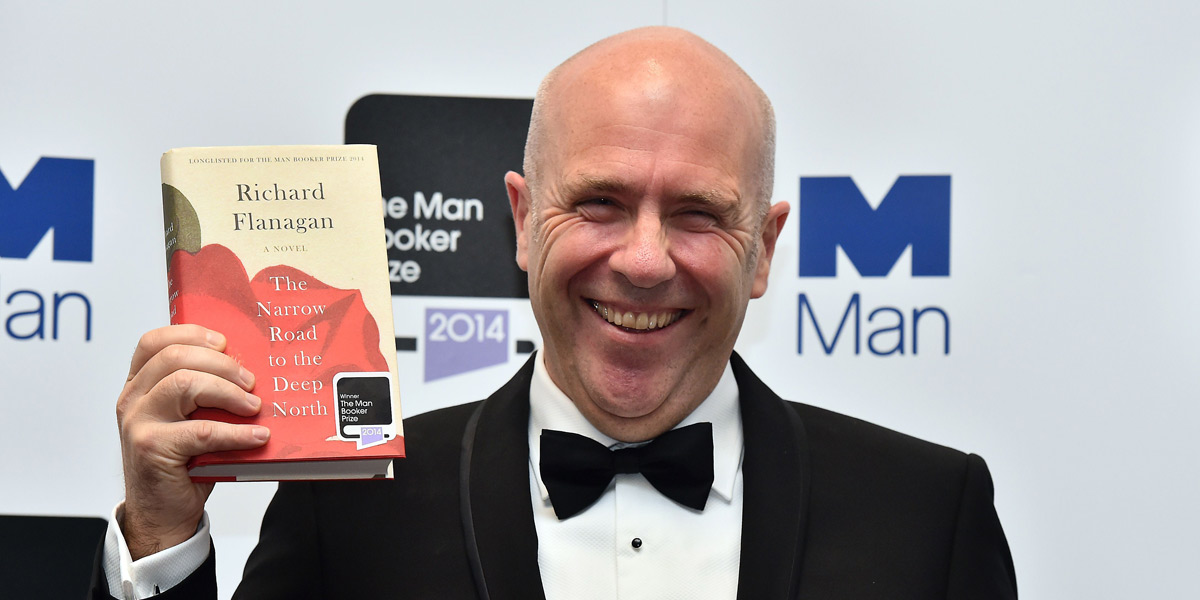
Australian writer Richard Flanagan has won the prestigious Man Booker literary prize for his prisoner-of-war novel The Narrow Road to the Deep North.
Flanagan, only the fourth Australian to win the Man Booker in its 46-year history, hugged the Duchess of Cornwall as she presented him with the award at a ceremony at the Guildhall in London last night (this morning AEDT).
His 100,000-word novel, named after a Japanese book by the haiku poet Basho, is inspired by the experiences of Australian prisoners of war in a Japanese camp on the Thai-Burma “death” railway. It is described as a love story which unfolds over half a century between a young surgeon (one of the POWs at the camp) and his uncle’s wife.
Flanagan’s own father, Archie, was a survivor of the death railway and the book is dedicated to him.
The 2014 Man Booker judges said the book was “a harrowing account of the cost of war to all who are caught up in it”.
“The two great themes from the origin of literature are love and war: this is a magnificent novel of love and war,” said chair of judges AC Grayling.
You might like

“Written in prose of extraordinary elegance and force, it bridges East and West, past and present, with a story of guilt and heroism.
“This is the book that Richard Flanagan was born to write.”
The 53-year-old Tasmanian was the only Australian on this year’s shortlist for the award, which carries STG50,000 ($A91,265) in prize money and is now open to any author writing originally in English and published in the UK. Other shortlisted novels were: Howard Jacobson’s J, Ali Smith’s How to be Both, Neel Mukherjee’s The Lives of Others, Joshua Ferris’s To Rise Again At a Decent Hour and Karen Joy Fowler’s We Are All Completely Beside Ourselves.
Flanagan told the audience at the awards ceremony that he didn’t come from a literary tradition, but rather from a rainforest on an island at the end of the world.
“My grandparents were illiterate and I never expected to stand here before you in a grand hall in London as a writer being so honoured,” he said.
“Perhaps in consequence, I do not share the pessimism of the age about the novel. They are one of our greatest spiritual, aesthetic and intellectual traditions.”
Subscribe for updates
The author told reporters that the prize money would help him continue to write. He said he was not a wealthy man, and when he finished the book abut 18 months ago, he had been considering looking for work in the mines because he had spent so long writing it.
The book’s Australian publisher, Penguin Random House Australia, said the win was an immense achievement.
“I have worked with Richard Flanagan for nearly 20 years, and I have always known in my heart that he is one of the most original, talented, creative and exciting voices writing in the English language,” said Flanagan’s publisher, Nikki Christer.
“With this accolade, we have confirmation that he is also one of the most important.”
The Narrow Road to the Deep North also saw Flanagan shortlisted this year for the fourth time for Australia’s Miles Franklin Award, but it was the first time he has been shortlisted for the Man Booker Prize.
Last year’s winner of the prize was New Zealander Eleanor Catton, with her historic novel The Luminaries, set during the gold rush era. Previous Australian winners of the Booker are Thomas Keneally (1982), Peter Carey (1988 and 2001), and DBC Pierre (2003).
Keneally has described The Narrow Road to the Deep North as “a grand examination of what it is to be a good man and a bad man in the one flesh and, above all, of how it is to live after survival”.
– with AAP
Click here to read InDaily’s review of Richard Flanagan’s The Narrow Road to the Deep North.
Want to see more stories from InDaily SA in your Google search results?
- Click here to set InDaily SA as a preferred source.
- Tick the box next to "InDaily SA". That's it.
Free to share
This article may be shared online or in print under a Creative Commons licence