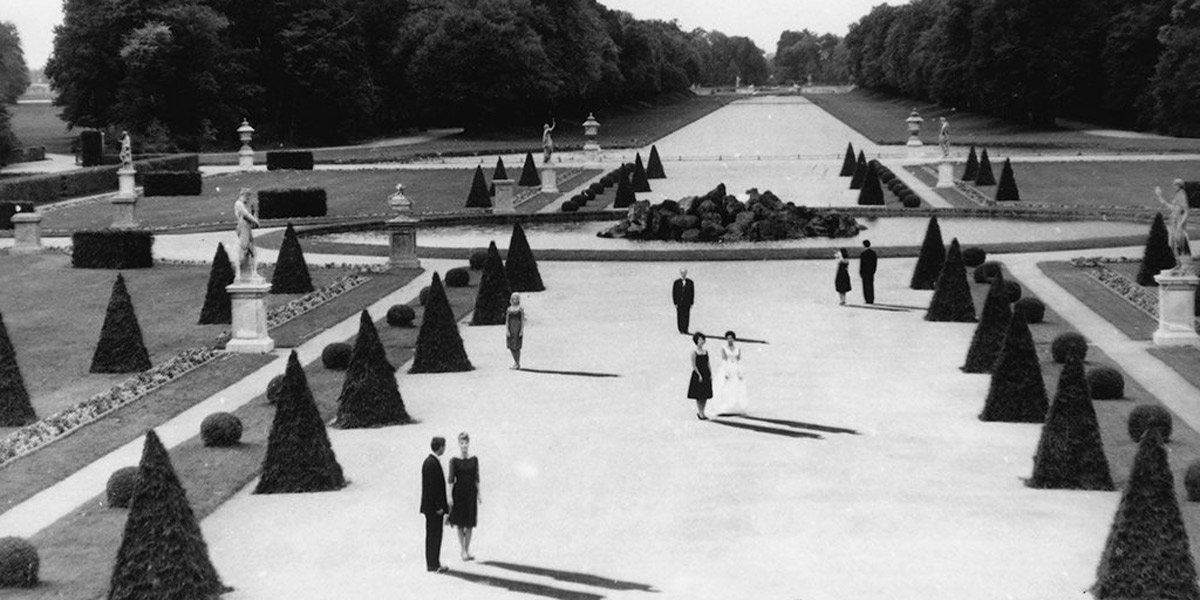
In the film Last Year at Marienbad (1961) there is a famous scene in which the characters stand in an 18th-century French garden between rows of manicured trees. Under a bright sun they cast shadows onto the ground. But the trees cast no shadows.
Asked why, the director Alain Resnais replied: because the people are “there and something”, but the trees are just “there”.
For too long Australian artists have been treated as just “there”. A matter of investment, return, externalities, multipliers, soft diplomacy, diffusion, integration, spill-over effects. The faces behind the functions are not, unless they are celebrity faces, often on display.
People spend their lives contributing to the culture of this country, to its unique quality of life. Art is all around us, all the time. Where does it come from? It’s just “there”.
If nothing else, the Senate Inquiry into the 2015-16 arts budget cuts is a reminder that artists’ lives are “something”.
Last Friday, it was South Australia’s turn. Five senators (Glenn Lazarus, Anne McEwen, Catryna Bilyk, Scott Ludlum, and Linda Reynolds) met a stream of writers, directors, dancers, musicians, producers, young artists, old artists, disabled artists, artists working for large organisations and for smaller ones, in the cities and in the regions, peopling a policy process wedded to figures and formulas.
The witnesses spoke plainly and they spoke well. Without puff or plangent complaint, with a precision which belies accusations that artists are muddled thinkers and special pleaders, they stated their views.
These varied in detail but not in essential message: the newly formed, already-much-maligned National Program for Excellence in the Arts (NPEA) is a mistake, not only in aims and impact, but in the way it is being foisted on an unprepared sector in the middle of a reform process the Government itself initiated.
You might like
South Australia’s arts sector is, in the words of Geordie Brookman, artistic director of the State Theatre Company, “small but perfectly formed”. If the planned cuts to the Australia Council go ahead, only eight of 18 smaller companies are expected to survive. If by a miracle more pull through, they would be heavily reduced in scope and operation.
The refrain being heard around the country is that the Council spent two years undergoing a review accompanied by extensive consultation to produce its current Strategic Plan, launched in August 2014. Then Arts Minister Senator George Brandis endorsed it as reflecting “the priorities of the new Government […] for a culturally ambitious nation”.
Then he ripped the guts out of it in the May 2015 budget.
When they were first announced, the changes didn’t make much sense. On closer inspection they make no sense whatsoever. Small arts organisations are numerous, diverse, broadly distributed, and risk-taking. They are also in close symbiotic relationship with larger ones.
So not only do the cuts rob Peter to pay Paul, they let Peter die of starvation while Paul loses his best mate.
The incoming Minister for the Arts, Mitch Fifield – who has replaced Senator Brandis – faces a stark choice. He can continue to pursue a policy of skewed resource allocation without agreed parameters and criteria. Or he can revert to the 2014 Strategic Plan.
That doesn’t mean the NPEA has to be dumped (though it does look a duplication of bureaucracy). It does mean – and this is the crucial point – it must be supported with new money.
Otherwise, as Helen Bock from Country Arts Network SA put it at the inquiry:
"“Instead of the haves and the have-nots we’ll get the have-mores and the have-nots. The arts will lose their middle class.”"
At the top end of town, Neil Armfield, the incoming co-artistic director of the Adelaide Festival, talked about the “culture of contraction and fear” in the sector, pointing out that “success breeds success”, so that currently the NPEA feels like a vote of no confidence in our national culture.
Subscribe for updates

The arts ministry has changed hands in the middle of the inquiry with a report due in November and hearings to come in Cairns, Darwin and Sydney. Can Fifield combine responsibilities to communications and the arts better than his predecessor combined the arts and law?
For the sector, anyone will be a welcome change from Senator Brandis, whose self-confessed passion for culture made the arms-length principle underlying this portfolio difficult to honour.
And perhaps this is the deeper point. Though the focus of the inquiry is on the budget, witnesses spoke about much more than money. The point they made was about the interconnectedness of the arts ecology.
To whit: you can’t take funding opportunities away from emerging artists and expect to have established ones in 20 years.
When Vicki Sowry, from the Australian Network of Art and Technology, said she wished she were a plumber, the room rippled with sympathy. Because plumbers don’t have to endlessly justify what they do. Because plumbers can just get on with their jobs.
Artists, by contrast, often feel they face an antipathetic blend of ignorance, neglect and disrespect. When the Government is involved, artists become “clients” and the particular skills that make up their heterogeneous sector get lost in what political sociologist Michael Pusey pointedly calls “a transcontextual commensurability of reference”.
So it is profoundly important that the inquiry is allowing so many artists to speak their piece, and do so in a way not limited to the usual types of (statistical) reporting. This is the real win out of the hearings. In the words of young musician Ross McHenry, a witness toward the end of the day:
"“The inquiry is like the consultation that never happened.”"
Plenty of hard data was presented, most notably by the South Australian Government, which, uniquely for a state government, appeared as a witness. But feelings, interpretations, histories and, most importantly, values were also up for airing, allowing the Senators – and through them, us – a more rounded view of what happens in the sector.
The testimony being presented at the inquiry is “there and something”, showing the lived experience of Australia’s arts ecology in action.
Julian Meyrick is Professor of Creative Arts at Flinders University; Tully Barnett is a Research Fellow, School of Humanities, Flinders University. This article was first published on The Conversation.
Want to see more stories from InDaily SA in your Google search results?
- Click here to set InDaily SA as a preferred source.
- Tick the box next to "InDaily SA". That's it.
Free to share
This article may be shared online or in print under a Creative Commons licence