Adelaide Festival review: Blindness
Immersed in near-darkness and wearing headphones with 3D sound, the audience at Blindness is plunged into a plague like we’ve never known.
Had enough of COVID-19? Try this calamity on for size.
A red light turns green, but no one is moving. “I’ve gone blind,” the culprit tells the angry, immobile drivers knocking on his window. He is the first, and soon the whole town, the whole country, has gone blind.
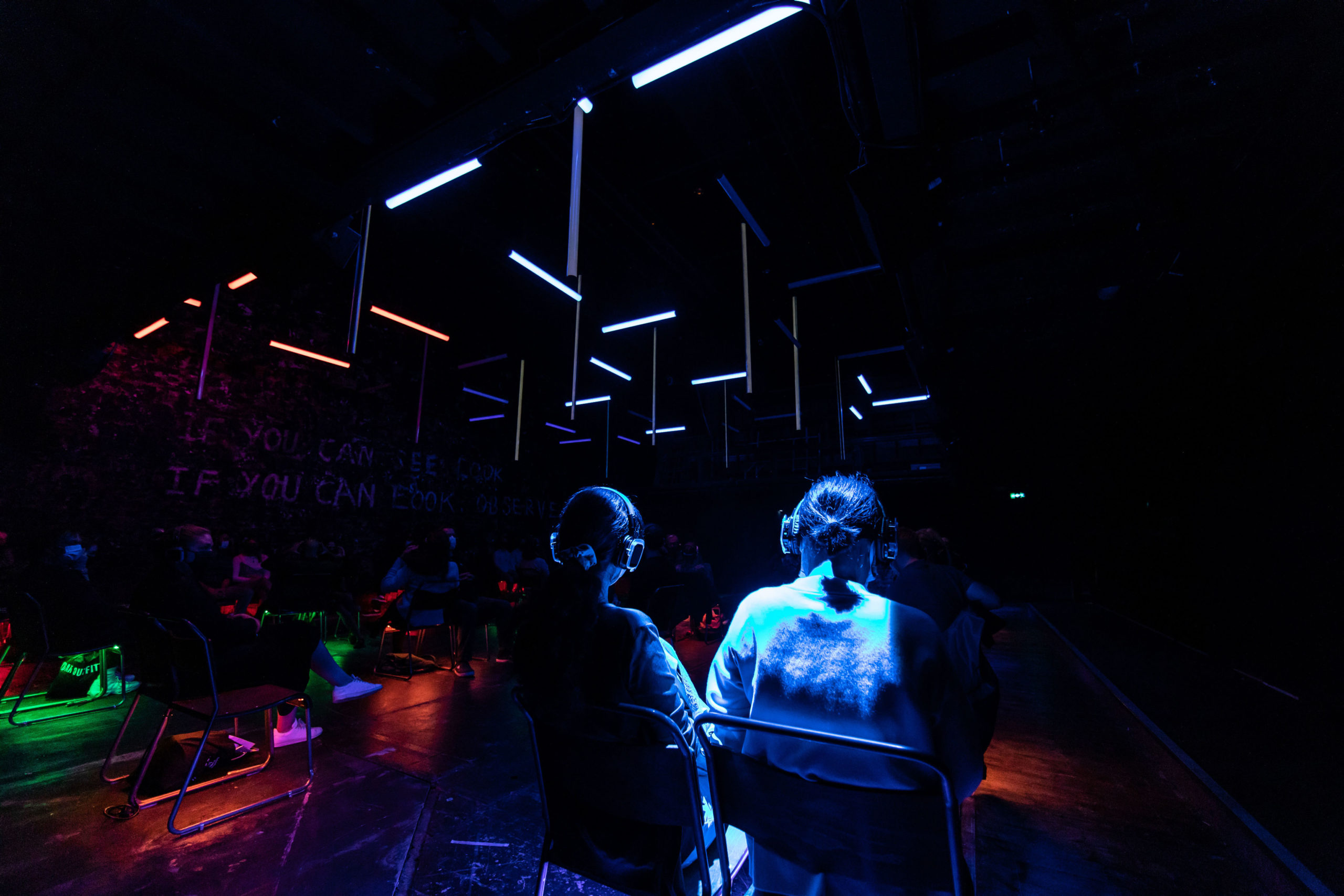
At the minimalist and perfectly chosen Queen’s Theatre, white-painted besser blocks display words from the 16th-century Book of Exhortations: “IF YOU CAN SEE, LOOK / IF YOU CAN LOOK, OBSERVE”. These same portentous words serve as the epigram to the 1997 book Blindness, by Nobel Laureate José Saramago, the basis for this sound installation production of the same name by London-based company Donmar Warehouse.
Voiced by multi-award-winning actor of stage, film and television Juliet Stevenson, Blindness’s narrator – also known as “The Doctor’s Wife” – is hurried and enraged. She’s the only person who can see, yet she’s chosen to pretend she’s blind so she can stay with her husband in the asylum where those first infected are sent. The asylum becomes more like a jail as the days add up. Soon there’s not enough food, and there’s no access to medical treatment. People die. It’s impossible to not think about our refugees, locked in detention centres or city hotels – a prison is a prison.
It’s a big secret, The Doctor’s Wife’s intact-sight, and we, the audience, are in on it. Binaural technology and immersive sound design (by Ben and Max Ringham) ensure we hear her move all around us, from our right to our left, as if she’s pacing and whispering in our ears. We’re the people in whom she’s confiding. She’s speaking, desperately, to us.
You might like

The effect of Stevenson’s voiced anxiety without the visuals to accompany this theatre creates a sense of urgency. Sometimes it sounds as though she’s on the other side of the room from us, screaming at people we haven’t a perception of, which enhances the fear and confusion. It’s a different kind of bodily experience for those who commonly use a combination of both sight and sound to make sense of a situation.
The move from Saramago’s Blindness to director Walter Meierjohann’s version is a big leap, with Olivier and Tony-award-winning writer Simon Stephens responsible for the adaptation.
The book is told in Greek-chorus style – polyphonic, meaning “many voices” – and that’s the way Meierjohann envisaged the play in 2004, when he first decided he wanted to stage it: 100 people on a stage. As he recently told InReview, he felt that the rise of right-wing politicians in Germany, where he was living at that time, fitted the metaphor of blindness. His idea for the play ended up being put on the backburner several times … and here we are, in 2022, in the throes of a global pandemic, and the timing couldn’t be more perfect.
The fact that Blindness has morphed into a sound installation with only one actor is a testament to the concept’s longevity and its adaptability – it was first staged in London in 2020 as a socially distanced performance when COVID regulations for theatres remained tight. But while it may be convenient to have the narrator as a single character describing to us the visible devastation all around her, that also means a sighted person is the sole storyteller.
Subscribe for updates
In Saramago’s vision of a plague-afflicted society, those who go blind loot stores, which are then abandoned; people starve and dogs feast on their corpses; the city is clouded in smoke and embers; rusted and abandoned cars litter the roads; there are no utilities or water; people are unable to bathe and somehow end up defecating in public. What his book says about the blind community is abysmal, and this adaption stays true to the story. However, the creators of this Blindness veered away from staying true to how the story is told.
Donmar Warehouse worked with a visually impaired production consultant, Professor Hannah Thompson, who has written that while many blind or partially blind people find Saramago’s portrayal of blindness offensive, she believes the use of immersive binaural technology delivers important messages about the value of the non-visual senses. “This adaptation is the perfect place to challenge misconceptions of blindness because it gives us a powerful aesthetic experience without any need of sight,” she comments on in a blog post.
Unfortunately, though, the audience at the Queen’s Theatre wasn’t submerged in total darkness, so the impact of this aspect of the experience was lessened. Rather, we were bathed in a dim light; if I opened my eyes, I could see the man in front of me.
Choosing to have the one person who can see – the story’s “hero” – as the only voice in the production is problematic. It doesn’t sit well with this reviewer. I would prefer to hear a blind person telling a blind person’s story, or a story in which a blind person saves a group of blind people from Armageddon.
Blindness is playing at Queen’s Theatre until March 20 as part of the 2022 Adelaide Festival.
Click here for more 2022 Adelaide Festival coverage.
Want to see more stories from InDaily SA in your Google search results?
- Click here to set InDaily SA as a preferred source.
- Tick the box next to "InDaily SA". That's it.
Free to share
This article may be shared online or in print under a Creative Commons licence