In the studio with Carly Tarkari Dodd and Dominic Guerrera
With a friendship spanning two decades, Carly Tarkari Dodd and Dominic Guerrera’s collaborative residency in the Adelaide CBD pays tribute to First Nations protest and “raw” conversations.
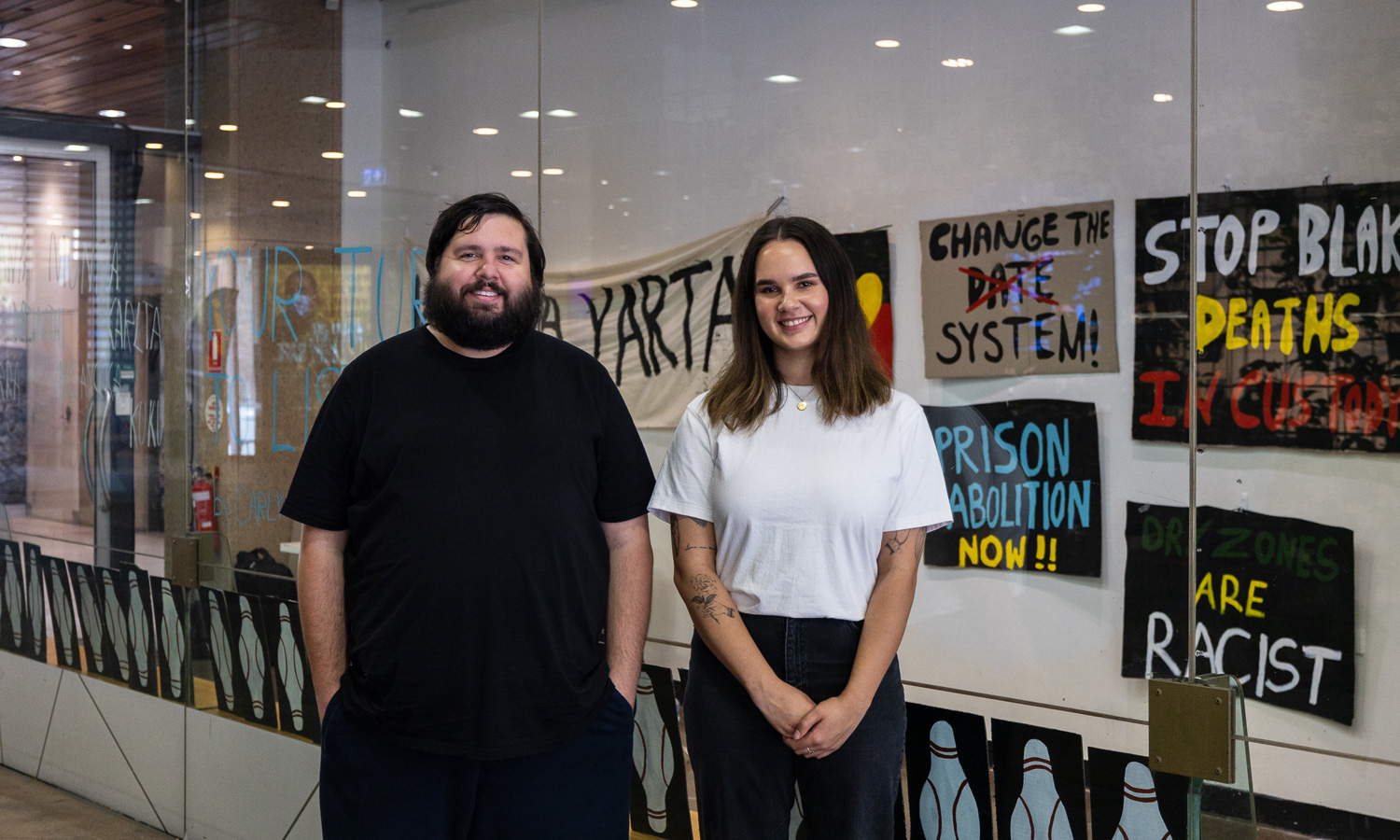
The City of Adelaide ArtPOD is a bit like a fishbowl; a narrow space with floor-to-ceiling windows facing onto the pedestrian thoroughfare that runs beneath the council’s brutalist concrete headquarters on Pirie Street.
Today, the pod’s walls are hung with painted cardboard signs bearing slogans like “Land Rights Now”, “Stop Blak Deaths in Custody” and “Still Here” – the kind of messaging more readily seen protesting outside government buildings than within them.
In the two decades that Kaurna, Narungga and Ngarrindjeri artist Carly Tarkari Dodd and Ngarrindjeri, Kaurna and Italian poet and curator Dominic Guerrera have known each other, such protests have played an important role for their community and their own development as First Nations artists.
“Carly’s mum used to work in [health centre] Nunkuwarrin Yunti; that was the first job that I got out of uni,” Guerrera says. “Every once in a while Carly and her brother would pop in, and that’s how we met – when Carly was a little kid.”

“I was three,” Dodd adds, sitting across the table as the pair carefully daub cardboard rectangles with black paint.
“Growing up I was always involved in community events and protest,” she says. “But it didn’t cross over into my art until a couple of years ago.”
You might like


“I grew up in protest, and you always attended protests as well,” Guerrera says to Dodd. “When we were talking about ideas for this [residency], we kept coming back to protest.”
The pair’s residency in the ArtPOD is a homage to decades of First Nations protest and community activism, paying respect to the generations who came before them while drawing attention to burning questions that remain unresolved.
They also plan to use the space to host a podcast series featuring conversations with other members of First Nations communities.
“It’s just going to be very raw 30-minute conversations with people – I’m not going to edit them, we want them raw. Literally just people sitting around,” Guerrera explains.
They’ll eventually create a zine reflecting and responding to those discussions, but for now, the signs offer plenty of talking points to passing foot traffic. When we speak just a few days out from January 26, one sign is particularly timely: “Change the Date System.”
“I love this sign – not the ‘date’, but the ‘system’, because that’s really what is at the heart of this,” Guerrera says. “Changing the date doesn’t solve the problem, [doesn’t] solve what we’re talking about.
“How can a country celebrate itself when it hasn’t even rectified its darkest actions or behaviours? What are you celebrating?”

Subscribe for updates
Guerrera also expresses scepticism about the current conversations surrounding the proposed Voice to Parliament – after all, the problem isn’t that Aboriginal people haven’t been speaking up. “It should be ears in parliament, because that’s what’s been missing – white people listening.”
Truth-telling should come first, Guerrera says. This is exemplified by another sign – “Dry Zones Are Racist” – that offers a pointed rebuke of controversial policies that have been adopted by councils in Port Augusta, Ceduna, and the City of Adelaide itself.
“We were waiting for a phone call but we never got it,” Guerrera says with a hint of defiance.
The issue, they explain, is that dry zones give licence for already over-policed and disadvantaged people to be further targeted and controlled.
“If white kids accidentally stumble upon Victoria Square, drinking after the Fringe, they’ll probably get a caution,” Guerrera says. “But homeless people and transient people, and particularly Aboriginal people who fit into those categories, they’re the ones who are picked on – the paddy wagons get called.
“Then it’s about getting them fines, getting caught up in the court system, the prison system, keeping those people in check and caught up in that system so they can lock them up whenever they want, invade their personal privacy.”

It’s one example of how decisions made by councillors and bureaucrats in air-conditioned offices like the ones above the ArtPOD can play a role in continuing the process of colonisation into the present day – and what makes protesting so essential.
As they bring these truths to the city’s doorstep, Dodd admits the ArtPOD’s fishbowl quality can feel “intimidating”. “Because you’re so exposed,” she says. “Especially when you’re making this kind of work. You don’t know what response you’ll get from somebody walking past.
“It’s obviously good to have this sort of exposure – we often see people stopping and sometimes take photos. [But] sometimes you do get some eyerolls.”
Guerrera adds: “I also think this stuff should be out in public, in white spaces. So that they know we’re still having these conversations.”
Carly Tarkari Dodd and Dominic Guerrera are artist and writer in residence in the City of Adelaide ArtPOD, 25 Pirie Street, until February 28. The residency is facilitated through Guildhouse’s ARTWORKS program.
In the Studio is a regular series presented by InReview in partnership with not-for-profit organisation Guildhouse. The series shares interesting stories about South Australian visual artists, craftspeople and designers, offering insight into their artistic practices and a behind-the-scenes look at their studios or work spaces. Read our previous stories here.
Want to see more stories from InDaily SA in your Google search results?
- Click here to set InDaily SA as a preferred source.
- Tick the box next to "InDaily SA". That's it.
Free to share
This article may be shared online or in print under a Creative Commons licence