Cabaret Festival review: An Australian Songbook
Assembling an intriguing selection of Australian songs and sources, including some doozies of her own, Robyn Archer and her versatile trio return to the Adelaide Cabaret Festival in fine form.
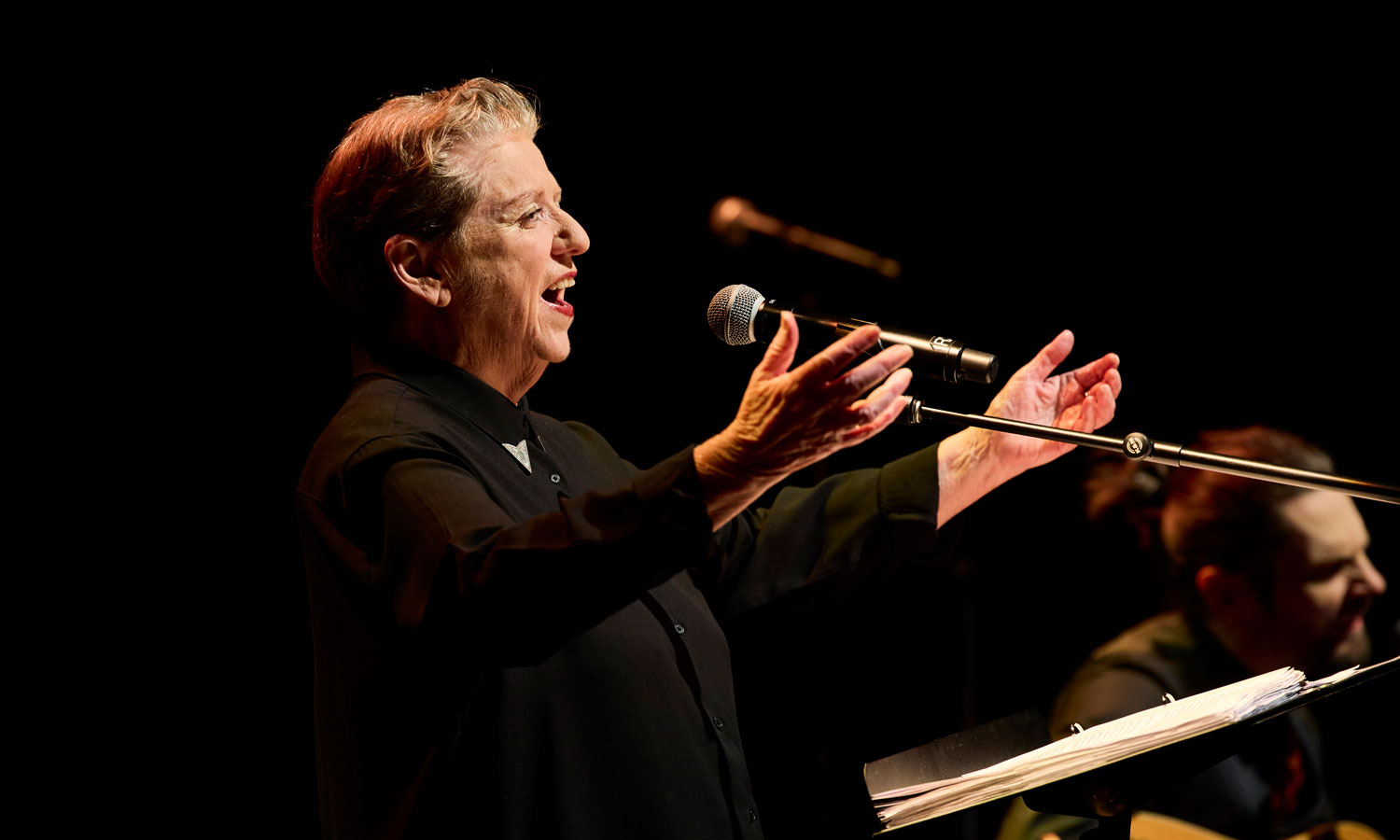
Robyn Archer is a highlight in any festival. And her appearances at the Adelaide Cabaret Festival always remind us what the best of that rubbery term “cabaret” actually looks and sounds like. With her musical prowess, her exuberant erudition and her keen wit, she is unique. As a tireless advocate for emancipation and social justice, she is the real deal.
Archer is an authority on the much-celebrated German Weimar period of music between the world wars. Over her career she has researched, produced and performed material from Broadway to Berlin, Paris and the UK. She has also drawn and gained stature from collaborations with music and theatre scholars John Willett and Michael Morley. Her 2013 Cabaret Festival show, Que Reste T’il, featuring Morley at the keyboard, was a French affair. Mother Archer’s Cabaret for Dark Times, delayed by COVID-19, appeared in 2021 to shed light on, and sometimes make light of, the parlous political and pandemical woes that we still inhabit.
So when Archer turns her hand to compiling an Australian Songbook, it is definitely not going to be a Greatest Hits of the Bleeding Obvious. She always has an eye and ear for forgotten gems, quirky anomalies, transgressive ditties and deliberately suppressed voices.
Throughout the show her running commentary gives plenty of credit where it’s due. Her list is not holier than Slim Dusty or Peter Allen, Chisel or the Oils, Ruby and Archie, The Waifs or Men at Work, who are all named and saluted along with a multitude of other musicians, especially women. But, all the same, she isn’t going to be singing “Khe Sanh” or “Down Under”.
Opening with the wryly satirical “I Am Not Nor Will I Ever Be” (a song from 1988), she nails her doubloon to the mast. She is not, nor will she ever be – Crocodile Dundee, or Barry McKenzie-ee, or, for that matter, Dr Germaine Greer. Then, slipping into some phrases from “Bound for South Australia”, she declares her heritage: English migrant parents, family home in Broadview, Port Adelaide. And by way of introducing the excellent band: guitarist and banjo player Cameron Goodall is of Celtic heritage; the forebears of ace accordionist George Butrumlis are Greek, and keyboard player Enio Pozzebon is Italian.
You might like

Moving to a rousing First Nations song, Yothu Yindi’s “Macassan Crew” (from their Garma album), Archer reminds us that the trepang fishermen from Sulawesi visited these shores long before the European invasion. She follows with a haunting reading of a Dja Dja Wurrung song about a birthing tree, “Jaara Nyilamum”, written by Yorta Yorta woman Lou Bennett and arranged by Iain Grandage.
For a thumping version of Goanna’s “Solid Rock”, Cam Goodall takes the lead vocal and the band gets in the groove. But Archer then moves away from familiar fare with a poem by Rev John Garvie (published in 1829, under his pseudonym Anambaba), “Plains of Emu”. Songs celebrating the natural landscape feature but there are sinister undertones. “Song of the Standard Lamp” refers to a gallows tree, and the title “Dark Cloud” (with music by Andrew Ford) tells us much.
When the focus moves to the fleshpots of the early days of Sydney’s Kings Cross and Darlinghurst with “Palmer Street Blues” and Kenneth Slessor’s “Choker’s Lane”, the band is in full blues swing – Goodall on electric guitar and Pozzebon rolling barrelhouse piano chords – but the mood is still menacing and grim. As a coda, Archer’s musical setting of Michael Dransfield’s poem “Outback” (from her 1978 The Wild Girl at Heart album) reminds us of the ravages and plunder of Australian resources – “like mined and gutted countries anywhere”. It concludes: “Our leaders betray us, sell our heritage / what remains is not worth stealing / and so becomes an army weapons-range.”

Subscribe for updates
It isn’t really an Archer event until she has a good yodel. Reminiscing on her mother’s love of country and western music, she leads into the bucolic “Murray Moon”, Goodall strumming banjo, syncopations on the piano and Butrumlis suave on accordion. Joy McKean’s “Gymkhana Yodel” takes us on an ambitious four-part glottal quivering harmony – ending in triumph for all concerned.Archer’s own compositions conclude the first half. Dating back to her early days as a performer in the late ’60s and early ’70s, the titles tell all. Her not-so secret women’s business, she calls them: “The Backyard Abortion Waltz”, “The Menstruation Blues” and “The (m-m-m) Menopause Blues”.
There is a surge of recognition and celebration from many in the audience. This is the Archer who broke boundaries and taboos way back then. The equal to Greer, Anne Summers and so many other progressive Australian women.
After interval the foot is still on, well, the throat. A song she wrote 25 years ago and which is more current than ever, “The Boys” (co-written with Cathie Travers), speaks to the current toxic behaviour in Canberra as if it were composed this week. Kate Miller Heidke’s “The Facebook Song” adds another dimension to the role of anti-social media.
Perhaps the highlight on this urgent theme is “Not Now Not Ever”, the Julia Gillard parliamentary speech against misogyny. With a choral setting by Rob Davidson, the lines of the speech are repeated in modal form. Led by Cam Goodall, the band harmonises behind Archer’s quietly iterated declaration. These are familiar lines, now made more compelling and strangely new. There are somehow echoes of Laurie Anderson. It is an inspired rendering.
Robyn Archer’s songbook contains multitudes. From Dorothy Hewitt’s “Weevils in the Flour” and Archer and Paul Grabowsky’s melodic but scathing “These are the Days” to lampoons of Menzies, Hawke and a song from Keating the Musical. The Archer classic “An Insect on the Windscreen of my Heart” gets a welcome go, and then, for an encore, there’s a mash-up number taken from 31 Oz songs with place-name references. Many are from Queensland, but finally Adelaide gets a name-check.
The crowd cheers and is soon on its toes. We always claim Robyn Archer back from wherever she’s been. On the day of her second and final show, June 18, she celebrated her 75th birthday. And supported by her lock-step, stylish band, she has never sounded better.
Robyn Archer performed An Australian Songbook at the Dunstan Playhouse on June 17 and 18 as part of the Adelaide Cabaret Festival, which continues until June 24. See more stories and reviews on InReview’s Cabaret Festival page.
Want to see more stories from InDaily SA in your Google search results?
- Click here to set InDaily SA as a preferred source.
- Tick the box next to "InDaily SA". That's it.
Free to share
This article may be shared online or in print under a Creative Commons licence