Revitalised early-music ensemble brings the best of baroque to Adelaide
Performances of Handel’s Messiah and other celebrated large-scale works from the baroque using historical instruments look set to become a regular feature in the city. It’s all part of a new raft of initiatives from Adelaide Baroque.
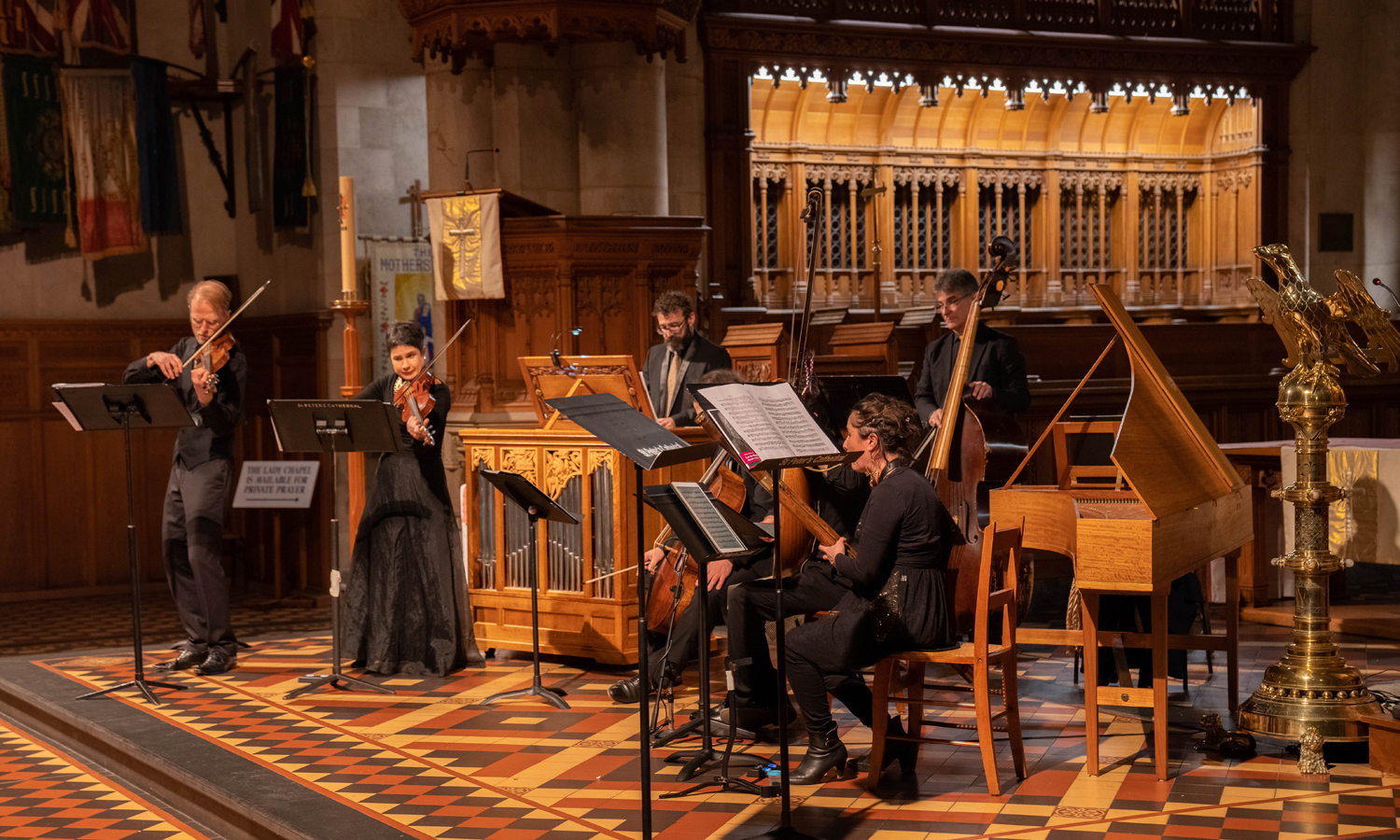
After testing the waters with performances of concertos and oratorios in its recent concerts, Adelaide Baroque have decided to go the whole distance and perform one of the largest and greatest baroque works in its original form – using an orchestra consisting of gut strings, natural trumpets, early oboes and harpsichord.
It will be a far cry from the usual way Messiah is performed with modern instruments, and to have this great oratorio resounding forth in St Peter’s Cathedral promises to be quite an occasion.
Two performances in December will bring together Adelaide Baroque Orchestra and St Peter’s Cathedral Consort for the first time under the direction of Anthony Hunt, the cathedral’s music director. Soloists will be Jessica Dean, Sally-Anne Russell, Andrew Goodwin and Pelham Andrews.
Behind it all is Rob Nairn, Adelaide Baroque’s new manager and a distinguished double bass and violone player with an extensive career in historical practice in the US – including holding professorships at the Juilliard School and Penn State University.
Nairn now teaches at the Elder Conservatorium and runs an early music program there. He became involved in Adelaide Baroque on returning from the US, at a time when this organisation – formed by Lynton Rivers, Anne Whelan and Lesley Lewis in 1977 – was thirsting to try out larger, more ambitious repertoire.
He hopes that December’s Messiah will lay the way for a whole new program of historically informed performances of choral and concerted works by Handel, Bach, Vivaldi and other early composers.
It all began, Nairn says, with Adelaide Baroque’s Café Zimmermann concerts that for many years were staged during the Adelaide Fringe. As many early musicians as possible were squeezed into the Burnside Town Hall to play cantatas and concertos by Bach and Telemann.
These concerts were “hugely successful”, he says, and created the impetus that led to Adelaide Baroque Orchestra’s formation.
“By this time, a groundswell of interest in the idea was occurring, brought about by a number of early music professionals coming back or relocating to Adelaide, and it meant that the time was right to start talking about a permanent orchestra,” Nairn explains.
You might like
Thus Adelaide Baroque Orchestra was born in 2018, and its debut under the direction of Italian violinist Davide Monti was overwhelmingly well received.
“The response was fantastic,” says Nairn.
“But we soon found we could only do one or two concerts a year with the larger ensemble. And of course COVID wrecked a lot of the momentum.”
Compounding matters, Adelaide Baroque were unsuccessful in applying for four-year State Government arts funding. The future looked extremely dire, recounts Nairn.
“A ship was on its way down, and it really annoyed me to see that they’d been around for more than 40 years. I just felt this was not the end.”

A desperate search for funding began to keep Adelaide Baroque afloat, and, remarkably, the organisation has actually been able to program more orchestral concerts in 2023 than before.
“It was a gamble, but it looks like it is paying off,” says Nairn. “So far what we have on paper for 2024 is bigger again.
“Critical to this success is that there are now enough professional baroque players in South Australia without having to bring a lot of people in.”
Messiah is a case in point. Only two musicians need to be flown in from interstate to fill out the orchestra; all the rest come from a now much-expanded pool of local players. Some of these are Adelaide Symphony Orchestra players with an active interest in historical performance, and others are students at the Elder Conservatorium of Music who are branching into the same area.
The latter come through a program called the Adelaide Baroque Academy. Presented in conjunction with the Elder Conservatorium and now in its third year, this brings together a faculty of nationally renowned lecturers to work with the Elder Conservatorium Baroque Ensemble and other Con students who are looking to gain initial experience in historical performance practice. Budding students from Marryatville and Brighton High Schools are also involved.

Subscribe for updates
“It’s an incredibly intense period for them,” Nairn says of the Academy. “But it enthuses and encourages them to realise that early music is not something that you might to do once you’ve mastered modern technique. Rather, it’s part of a whole process of learning.
“Ideally, one comes to appreciate the music of every period using historically accurate instruments and with an understanding of its language. Gaining that appreciation at an undergraduate level can be an incredible asset.”
Two public concerts are included as part of this year’s Adelaide Baroque Academy in September. The theme is French music of Lully, Rameau and Couperin.
If Adelaide can continue to increase its player base through this Academy, Nairn says it should be possible to hold regular large-scale baroque concerts here.
“I see a city of this size as one where we should not only have a couple of performances of Messiah on period instruments, but there should also be at least one St John or St Matthew Passion every year, or a Christmas Oratorio. Plus an oratorio series.
“There’s so much wonderful music from this period that it’s really hard to know what not to put in.”

While he was in the US, Nairn performed extensively with the biennial Boston Early Music Festival, and says he witnessed how public interest in historical performance escalated spectacularly as a result of this event.
"I hope to build the momentum up to create something that makes this city a real centre of early music in Australia"
“The coolest thing about a very cool festival was that its two directors, Stephen Stubbs and Paul O’Dette, would find an opera that hadn’t been performed in modern times. Then they would create a modern edition and this work would become the centrepiece. Clustered around it would be a small chamber opera and orchestral concerts as well.
“The festival’s focus was just extraordinary, and the orchestra came from all over the world. I kept thinking that I’d love to organise a similar festival here.
“I know there have been similar kinds of festivals in Adelaide in the past, but not an international baroque festival. There really isn’t one anywhere in Australia. So, ultimately, I hope to build the momentum up to create something that makes this city a real centre of early music in Australia.”
Nairn says the Boston Early Music Festival has indicated it is willing support such an initiative by, for example, sending out one of its chamber opera productions.
“It could be very exciting to liaise and align with an American company that has immense kudos and quality of achievement in this area,” he adds.
“That’s all in the future, but I’m thinking along these kind of lines.”
Adelaide Baroque Academy will present two concerts at Elder Hall, on September 19 and 22 (details here). Adelaide Baroque and St Peter’s Cathedral Consort will perform Handel’s Messiah on December 22 and 23 at St Peter’s Cathedral, with Anthony Hunt conducting.
Note: Graham Strahle has played with Adelaide Baroque on viola da gamba on several occasions.
Want to see more stories from InDaily SA in your Google search results?
- Click here to set InDaily SA as a preferred source.
- Tick the box next to "InDaily SA". That's it.
Free to share
This article may be shared online or in print under a Creative Commons licence