Book review: The Rocks Remain
This broad-ranging collection of Blak poetry and story brings together writers with a connection to South Australia and offers a panoramic view of place, identity and the ways they link together.
“Ignore the present. Forget the past. The rocks remain unmoved.”
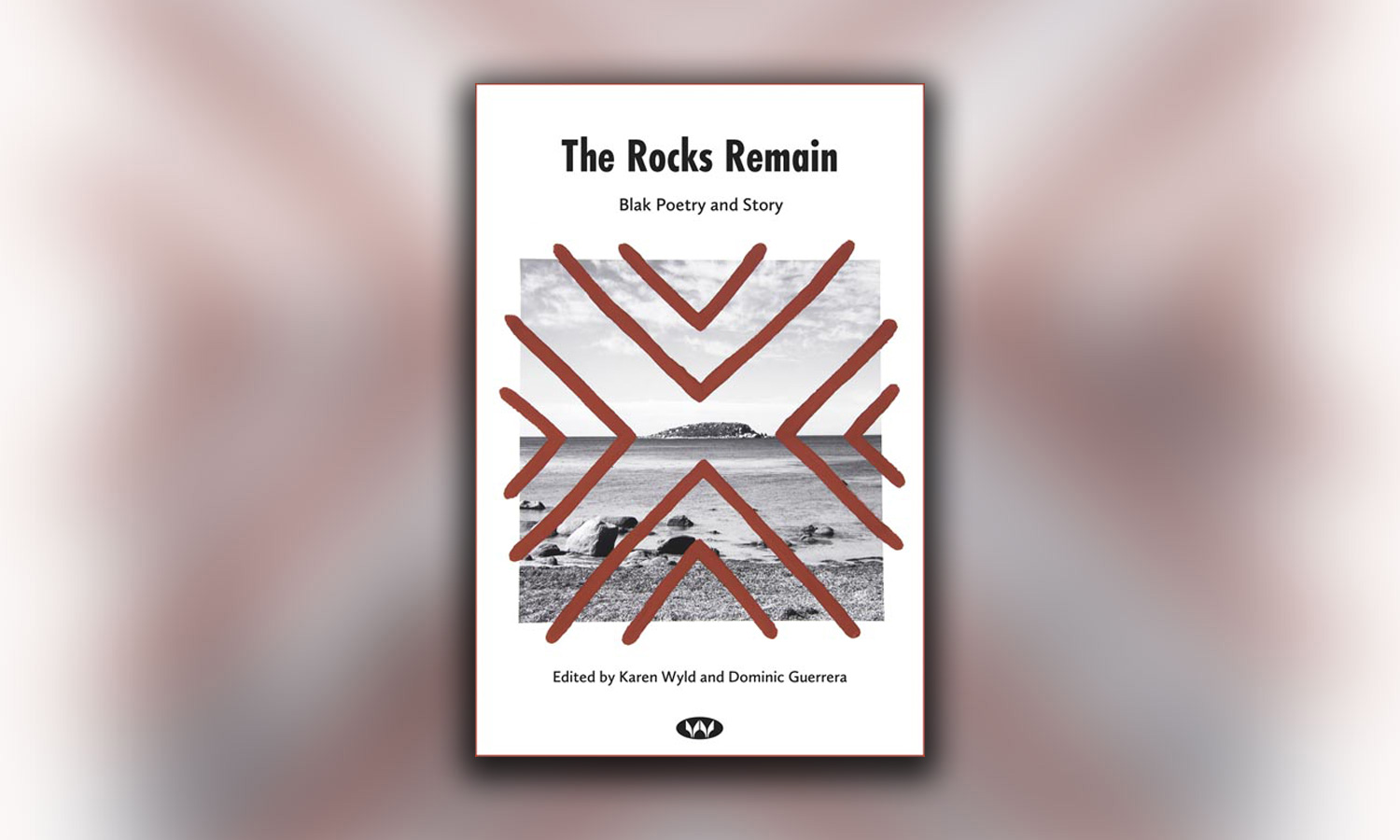
The title of this Aboriginal/Blak poetry and story anthology, The Rocks Remain, comes from Brad Darkson’s prose contribution waiting for kakirra. The phrase is a solid theme throughout the anthology, which features 25 emerging and established Aboriginal poets and writers, all with a connection to South Australia.
In the foreword, editors Karen Wyld and Dominic Guerrera say they didn’t “want the notion of borders to engender exclusion”. This was a great choice as it means, from the beginning, that connection to Country is at the forefront. The theme permeates the entire collection through various lenses, including environment, animals, language, and community.
Steven Pappin’s bilingual poem Away from Country, which uses both Barkindji and English language, and Angie Faye Martin’s Home Within Me evoke the feeling of Country, even without its physical presence. The writers show in different ways how Country never truly leaves us.
Barrina South’s Cockatoos vividly depicts the connection of Country through animals, while Ali Cobby Eckermann’s Spirit Gate illustrates the pull of Country on the character Trevor, a man who just knows that one day he has to go back home. Lulu Houdini’s Things Change delves into the solace found in returning home during tumultuous times, highlighting the significance of place and nature in knowing what you need.
You might like

These stories and poems don’t contain foreign ideas; people know the safety of home. But, there is an extra layer to the words as each author highlights exactly what makes their home so special.
The anthology also channels anger, not as a negative emotion, but as a catalyst for demanding change. Rick Slager’s Vermin-proof Fence laments the mishandling of fires and how nature takes a back seat to capital-driven ventures, while Dominic Guerrera’s unwelcome to country confronts systemic inequalities with unapologetic candour.
Dylan ‘Muldari Kor:ni’ Peisley’s You say Aborigine, I say Blak and Jayda Wilson’s you cut off my native tongue and here I am sewing it back on assert pride and resilience in the face of colonial attempts to erase culture and language. Sonja Rankine’s Black Lives Matter and Noah Amundson’s Blak Nation both express frustration at ongoing injustices and incomplete efforts at reconciliation.
Such stories make clear how little change actually takes place and how Aboriginal people are not, and never have been, okay with this. Each author demands a different way of working with Aboriginal people – showing that the current status quo cannot continue.
Subscribe for updates
The writing within this anthology also touches upon trauma and the strength in Aboriginal people because of what they have faced. In Daring not to Dream, Michael Larkin employs a circular structure to poignantly illustrate the ongoing loss of culture experienced by Aboriginal people, highlighting colonialism’s relentless and monotonous nature. Tarryn Poole and Alexis West both deal with generational trauma and family, with Poole’s My Body Remembers serving as a heartbreaking ode to what she faces day to day and its relationship with the experiences of the generations before her. West’s The Macadamia Tree grapples with similar themes using imagery of macadamias, a tree and her grandmother.
Tabitha Lean’s Queen Victoria’s throne no more and Natalie Harkin’s Blood-Memory Cultural Flows both offer poignant reflections on colonisation, discussing its impact across generations. Lean’s use of her mother’s voice to show how Country still exists in Tandanya is an incredible technique and her prose weighs heavily on the reader. Sheena Hayes tackles the topic in a different way, navigating the intricacies of love overshadowed by personal demons and haunting memories.
In That Branch. It Hums, Karen Wyld underscores nature’s resilience as a holder of stories, even in the face of the current climate, while Edoardo Crismani’s Sail employs sailing imagery to show his own resilience.
Trauma, we can see, is a complex battle that people continually push through with strength and resilience. While the pieces acknowledge that what has been experienced isn’t right, they also acknowledge that history, family and Country will continue.
There also remains a thread of hope and appreciation within this anthology. Shania Richards’ Powerful Unconditional poignantly narrates a tale of survival and familial strength, while Nancy Bates’ Ruby celebrates the determination of women in holding communities together. The carefully placed poems breathe life into the anthology, allowing the reader see a future that is hopeful. It shows that while the past cannot and should not be forgotten, the future has the chance to be different.
There are also warnings littered throughout. Kathryn Gledhill-Tucker’s speculative fiction piece, Campfire, serves as a cautionary tale, skilfully depicting a future where Aboriginal culture navigates a “big-brother” type world, offering readers a thought-provoking narrative that could easily become a novel.
Ben Armstrong’s fictional piece uses bururrgan and dirragarra (ibis and wombat) to wryly show how Country should be respected. The name of the villain in this piece is incredibly enjoyable and shows Armstrong’s skill in crafting a deep story with touches of humour.
The anthology is well written and thoughtfully structured. The threads between the stories flow easily and while each story has its own message, the whole anthology comes together to highlight the amazing writing embedded in South Australia. This is a book to read to see how Aboriginal people view the place that they call home.
The Rocks Remain, edited by Karen Wyld and Dominic Guerrera, is published by Wakefield Press and is available now.
Courtney Jaye is a Ngarrindjeri woman and writer who grew up all around Australia and is currently living on Kaurna country. She is a recipient of the Arts South Australia and InReview First Nations Arts Writing mentorship. Courtney is working with Martu author and freelance writer Karen Wyld to write a series of articles for publication in InReview.
Courtney did not work directly with Karen in her development of this review, but InReview acknowledges their ongoing mentoring relationship.
Want to see more stories from InDaily SA in your Google search results?
- Click here to set InDaily SA as a preferred source.
- Tick the box next to "InDaily SA". That's it.
Free to share
This article may be shared online or in print under a Creative Commons licence