Duelling with danger on the SE Freeway
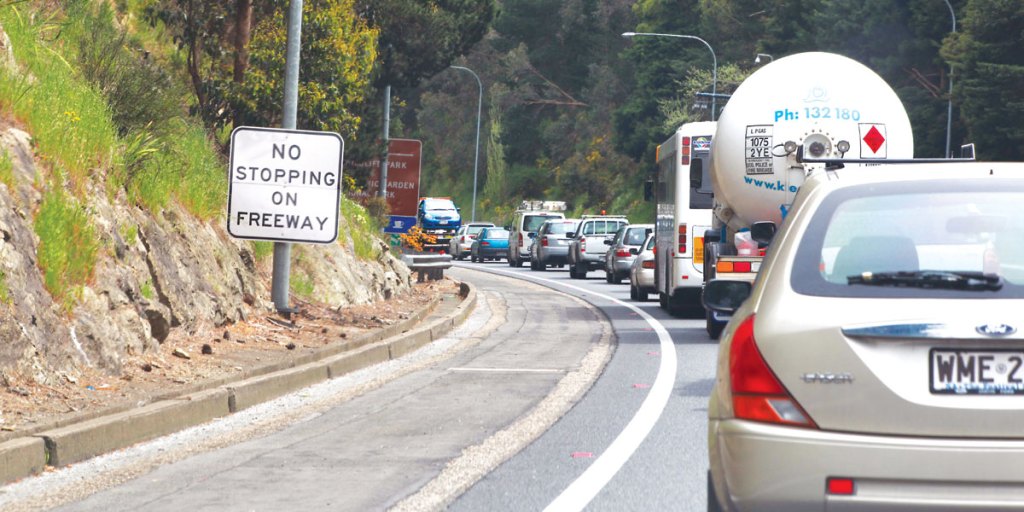
The carnage continued yesterday at the bottom of the South Eastern Freeway but the wonder for daily commuters who use the road is that it doesn’t happen even more frequently.
Just after 1pm a sewage truck went through the intersection of Glen Osmond Road and Cross Road and smashed into three stationary cars. One motorist was killed and three others are in a critical condition, including the truck driver. Police are investigating whether brake failure caused the collision.
It’s a familiar scene. In January, a semi went through the intersection at high speed in the early hours of the morning, smashing into the high retaining wall which protects the retirement village on the other side, killing the driver. In recent years, a runaway truck smashed into a restaurant several kilometres down Glen Osmond Road after losing control on the freeway and, in a separate incident, a man was killed waiting at a bus stop at the bottom of the freeway, again by an out-of-control truck.
Less attention is given to the many other fatalities on the freeway which occur along its length, some involving heavy vehicles. In November last year, a four-year-old was killed after a multi-vehicle crash below the tunnel involving a truck; in 2010, a woman was killed by a truck while she was stopped in the emergency lane near Hahndorf.
These are just a few of the recent tragedies on the freeway which sit heavily in the stomachs of daily freeway commuters, of which I am one.
Governments have made some responses, lowering the speed limit for five-axled vehicles to 60km/h on the steep downward section from Crafers to suburbia.
This morning, Road Safety Minister Tony Piccolo agreed to investigate whether the speed restriction should be applied according to weight rather than axles (yesterday’s crash involved a track with only two axles), which seems logical.
You might like


Federal junior infrastructure minister Jamie Briggs, whose electorate is centred on Mt Barker in the Hills, this morning encouraged the State Government to apply for blackspot funding for the intersection.
But the bigger issue is the safety of the entire length of the freeway – from Glen Osmond to Murray Bridge.
It is still treated largely as a freight and regional route – in reality it has become a major commuter road clogged with private cars and public buses after years of massive residential growth in the Hills.
Ironically, Briggs and his state counterpart, Transport Minister Stephen Mullighan, recently agreed to divert safety funding from the freeway to the overblown South Road project.
In July, it was revealed that about $8 million in funding for a proposed Advanced Traffic Management System had been whisked away to help fund the Darlington upgrade of South Road. The system would have allowed better management of traffic beyond Stirling in the case of accidents – such as variable speed limit signs – as well as shoulder sealing works.
It’s a symptom of the lack of attention paid by government to the freeway’s changed character and the impact of higher levels of traffic on the city feeder roads.
InDaily has reported previously that the State Government paid little attention to the effect of the Mt Barker expansion on city routes such as Cross Road, Glen Osmond Road and Portrush Road. Preliminary traffic studies were limited to volume assessments on the freeway itself.
We don’t know the cause of yesterday’s truck crash, but it does highlight the major concern of commuters – the uneasy relationship between high volumes of trucks and cars travelling at high speed on an increasingly clogged freeway.
Stay informed, daily
But we ain’t seen nothing yet. With thousands more homes set to be built in Mt Barker in the years ahead, it’s only going to get worse.
Here is a common scenario faced by freeway commuters on many days: you’re travelling at 110km/h and as you round a sweeping curve you must suddenly brake as you’re confronted by crawling traffic banked up in both lanes. Has there been an accident? No. Rather, an impatient truck driver has overtaken a fellow heavy vehicle driver who was going at a marginally lower speed on the up-hill track. The overtaking truck is now crawling along ever so slowly in the right-hand land, causing impatient motorists to bank up behind him, each one tailgating the car in front, as if some sort of mental pressure will cause the blockage to go away.
There are few more uneasy sensations than being at the tail end of such a freeway conga line. There’s nowhere to escape on the freeway when both lanes are full: you simply hope that the motorists behind you are paying attention; that you won’t be rear-ended at high speed.
On the down-track, the freeway can be even scarier.
Again, trucks travelling at speeds 40km/h or more lower than the other traffic will pull out suddenly and overtake other heavy vehicles, causing unexpected bank-ups and, commonly, causing cars to change lanes quickly or slam on the brakes to avoid a collision.
The tunnel downtrack is deceptively steep and it’s no surprise that the stretch of road just outside the tunnel exit is a hotspot for rear-end collisions.
Maybe another arrester bed at the foot of the freeway would help, although it’s difficult to conceive where it could be placed, given the geographic and traffic challenges along this stretch. Also, arrester beds are useless if drivers choose not to use them to avoid paying fees.
Maybe the speed limit along the freeway’s entire length needs to be reduced.
Certainly, variable speed limit signs from Stirling to Mt Barker would be a great help on that section of the freeway.
Authorities obviously need to pay greater attention to heavy vehicle operators using the freeway to make sure they’re complying with regulations.
But, above all, the biggest safety upgrade needs to happen between the ears of truck drivers and motorists who use the freeway.
It’s an issue flagged by Coroner Anthony Schapel in his findings on the death of John Posnakidis, who was killed by a semi-trailer while he was in a bus shelter at the foot of the freeway. Schapel found in February that the death could have been prevented if the driver had simply used low gear or utlised one of the freeway’s arrester beds.
Without reflecting on yesterday’s incident which is still under investigation, past experience has shown that regular commuters and professional drivers alike can become complacent, careless and impatient on their daily journey: and no amount of infrastructure upgrades can safeguard against that problem.
At about 1.15pm, a truck collided with three stationary cars at the intersection of Glen Osmond Road and Cross Road.
The driver of one of the cars, a 56-year-old man from Hallett Cove, was rushed to hospital but sadly died a short time later.
The truck driver, a 29-year-old man from Netley, and two other female drivers, a 41-year-old from Ingle Farm and a 48-year-old from Hahndorf remain in a critical condition at the Royal Adelaide Hospital.
Police are investigating the possibility of brake failure as a cause of the collision.
– See more at: http://www.sapolicenews.com.au/component/content/article/4-news/26572-fatal-crash-glen-osmond.html#sthash.w1HLWcnB.dpuf
Want to see more stories from InDailySA in your Google search results?
- Click here to set InDailySA as a preferred source.
- Tick the box next to "InDailySA". That's it.