Govt claims bull bar vindication
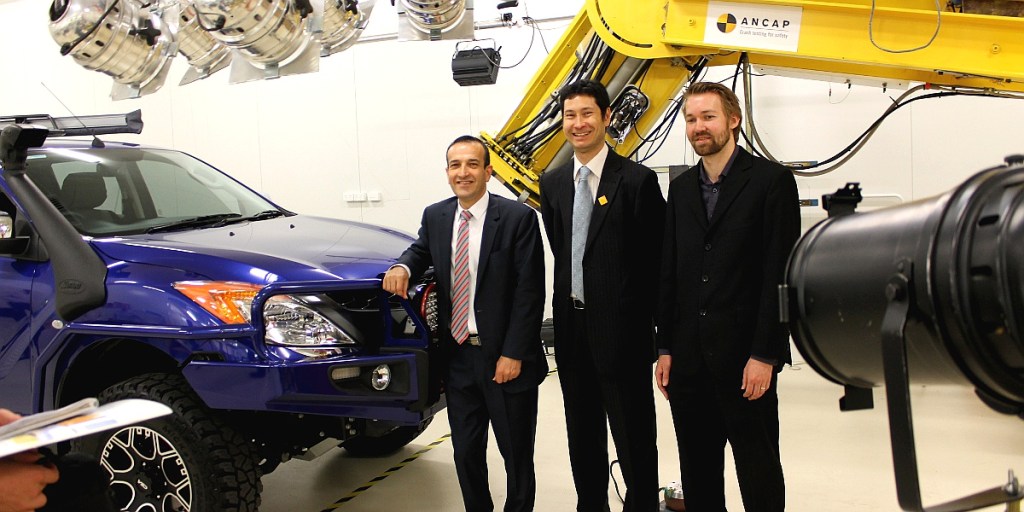
The State Government says an Adelaide University study has vindicated its decision last year to make the Australian Standard compulsory for new vehicle bull bars.
A study by the Centre for Automotive Safety Research at the University of Adelaide found that an SUV or sedan fitted with a non-compliant bull bar was more likely to seriously injure a pedestrian in the event of a crash than a vehicle with a compliant bull bar.
The study was funded by the Department of Planning, Transport and Infrastructure (DPTI).
“That chance of serious head injury is much greater if (bull bars) are non-compliant,” said research fellow Sam Doecke.
“It could also be an injury around the pelvis, so, internal injuries as well.”
Fellow researcher, Associate Professor Jeremy Woolley, said the research “shows that the adoption of the standard was a step in the right direction”.
You might like


Crash test dummy tests and computer models were used to simulate the impact of compliant versus non-compliant bull bars.
According to the study, vehicles fitted with non-compliant bull bars – such as those which angle forwards or upwards – were likely to slam a pedestrian’s head into the vehicle’s bonnet faster and with greater force than vehicles fitted with compliant bull bars, which angle backwards and conform to the shape of the vehicle.
“What the study shows is that we made a very good decision,” said Road Safety Minister Tony Piccolo.
“Just to reassure the market that we were doing the right thing, research was undertaken to show that it actually does achieve a good balance.
“(The compulsory standard) improves road safety for pedestrians, and at the same time, it doesn’t reduce the efficiency of protection for the vehicle and the driver.
Stay informed, daily
“Over 80 per cent of the market were already complying when we introduced the standard last year.”
DPTI research from 2011 found compliance with the standard for bull bars fitted to new vehicles was between 90 and 95 per cent.
It remains unclear how many non-compliant vehicles are on SA roads today.
Shadow Road Safety Minister Corey Wingard told InDaily he was pleased by the results of the Adelaide University study.
“If it improves safety, it can only be a good thing,” he said.
Doecke acknowledged a pedestrian hit by a vehicle with no bull bar at all would be safer than one with any type of bull bar, but said it was possible for bull bars to be “relatively pedestrian-friendly” if manufactured in line with the Australian Standard.
“You have pedestrian safety on the one hand, but there is a need for vehicle protection for people in rural areas,” he said.
“For a pedestrian, it is always better to not have a bull bar, of course, but this is about: if there is a bull bar, trying to help it be safer.”
Bull bars are often fitted to cars driven at high speed in rural and regional parts of the country, where the risk of hitting a large animal on the road is highest.
“The whole purpose of fitting a bull bar to a vehicle is to enable, in the event of an animal strike, to survive that and bring the vehicle to a halt in a very controlled manner,” said Matthew Frost of the 4-Wheel-Drive Industry Council.
“The consequences of hitting a kangaroo at high speed without a bull bar (are that) you’re absolutely guaranteed the vehicle will be immobilised.”
Frost cited a 2011 survey of Australian drivers, which showed that vehicles with bull bars which ran into an animal at speed were much less likely to sustain major damage or become totally immobilised than vehicles without bull bars.
The same survey showed that occupants of vehicles without bull bars suffered injuries in 20 per cent of animal strikes, whereas occupants of vehicles with bull bars were injured in less than one per cent of animal strikes.
Want to see more stories from InDailySA in your Google search results?
- Click here to set InDailySA as a preferred source.
- Tick the box next to "InDailySA". That's it.